Lace as a motif
The Florios of SicilyLace is a recurring motif through which the novel connects patient, often gendered labor with wealth, social display, and the Florios’ remaking of their world. It begins as an intricate textile made thread by thread, becomes a costly marker of Giulia’s uneasy position as Vincenzo’s wife, and finally takes architectural form in the lace-like stonework of his renovated tonnara. Across these appearances, delicacy is never merely decorative: it is labor made visible, a luxury claimed by the powerful, and an image of the structures people build around one another.
Craft, labor, and rarity
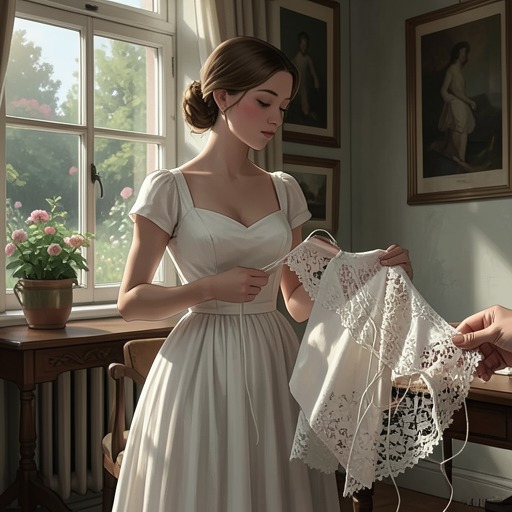
The motif first receives an extended material history. Cotton thread, needles, bobbins, and pillows establish lace not as an abstract emblem but as work performed with tools. Making even a few centimeters requires steady hands, patience, sharp eyesight, and the careful intertwining of thread along a subtle pattern. The small scale of the finished fabric conceals the duration and discipline demanded by its making.
That labor has a history of migration and changing markets. Burano lacemakers had supported their island through their craft for centuries; Catherine de’ Medici helped carry the practice to France by persuading women to teach it in convents. There lace became dentelle and ornamented the clothing of Europe’s wealthiest. Renowned schools shifted north, to Valenciennes, Calais, Brussels, and Bruges. The passage traces the craft across places and generations, showing how an apparently delicate luxury depends on skilled hands, learned techniques, and networks of transmission.
Industrial production threatens to displace that tradition: lace is machine-made in England, and Queen Victoria’s wedding veil is made of manufactured tulle. Yet handmade lace persists. Workers use bobbins to interweave thread faster, experiment with colored silk, and train poor girls in the trade. Its recovery is slow, and its eventual return to prominence in Venice does not make it common. Handmade lace becomes the preserve of a very small number of extremely wealthy families, a possession valued like a jewel. The motif therefore holds two conditions together: years of skilled labor and the exclusive privilege of owning its result.
A luxury in the household
When lace enters Giulia’s clothing, its value becomes intimate and socially charged. During an encounter with her mother-in-law, Giuseppina scrutinizes Giulia’s dress, lingering over its lace neckline. She calls the lace extravagantly expensive and the cut too low, comparing the garment to a theater dress. Her criticism makes the fabric a contested sign: it marks Giulia’s elegance and access to wealth, but also exposes her to judgment within the household.
Giulia answers that Vincenzo suggested she wear the dress. Giuseppina’s response—that he thinks like a man and likes certain things—turns the garment into evidence of the unequal terms on which its display is negotiated. The lace is not simply Giulia’s self-expression; its meaning is entangled with her husband’s preferences and her mother-in-law’s disapproval. The fabric that signifies refinement also makes Giulia feel observed and assessed.
After the encounter, Giulia returns to the main apartment shaken and seeks air at an open window. She looks at herself in a silk navy-blue dress, with pearls and a shawl over the neckline: French lace Vincenzo bought in Marseille while traveling with Augusto Merle. The detail gives the garment a concrete history of purchase and travel, while its status as a gift worthy of a princess emphasizes the distance between material splendor and personal security. Giulia wonders whether she is good enough for Vincenzo and fears that Giuseppina may be right to think she embarrasses him. Having had three pregnancies, she is conscious that her waist is no longer what it was; the lace frames her appearance at precisely the moment when she doubts her place in her husband’s public life. Its beauty cannot settle that doubt.
From textile to architecture
The motif’s most striking transformation comes at the tonnara. The courtyard has been remade as a front garden, with a trellis, trees, and potted plants breaking up the gray cobblestones. The low building has been raised into a house with large windows and a terrace facing the boat ramp; nearer the sea stands a square turret. This changed working site becomes the setting for an image that carries the earlier textile motif into stone.
The building seems covered in lace. Its four corners, described through the word pizzi, rise into peaks; Gothic lines evoke an English castle, while mullioned windows open toward the sky. Tuff inlay forms sinuous carved lines like lace. The resemblance is not simply ornamental: the intricate pattern once made by threads is now cut into the architecture of a place transformed under Vincenzo’s direction. The motif shifts from a precious fabric worn on the body to a permanent design worked into a building.
Vincenzo feels Giulia shiver beside him and takes her by the hand, telling her to come closer. He asks the nanny and his mother to wait. The new structure is thus revealed not as a detached object but as part of a personal encounter: Giulia is brought into the space, while the lace-like design joins beauty to the family’s shared setting. The building gathers the motif’s earlier associations—labor, expense, refinement, and status—and enlarges them into a visible act of making.
The motif’s wider resonance
Lace’s appearances sit within a novel attentive to commodities and the routes by which they acquire value. Spices travel through many hands, across long distances and into European ports, with costs rising at each stage; overseas trade and newly diversified markets alter who can sell them. The lace history follows a comparable pattern of movement: a local skill crosses borders, is taken up by distant centers, faces mechanization, and survives as an increasingly rare luxury. In both cases, value is shaped not only by the object itself but by labor, transport, access, and control of the market.
The motif also makes visible a contrast between kinds of making. Handmade lace requires patience and precision, while machine-made tulle can reproduce a related effect through industrial means. At the tonnara, the image is neither thread nor cloth: it is stone carved into delicate lines. Across craft, clothing, and architecture, the lace pattern persists while its material and scale change. That recurrence gives the design an unusual range. It can suggest an individual’s exposure to household scrutiny, a luxury limited to wealthy families, or a structure remade into a striking family space—without losing the reminder that intricate beauty depends on labor and on who has the means to claim it.